BOUNDARIES
Wherever people share ground, they also draw lines on it.
Some boundaries shelter what matters to us. Others shut out what we fear, and many do both.
Read moreRead less
This series looks at the places where terrain divides: fences, rivers, hedges, fault lines and thresholds. It doesn’t claim that boundaries are good or bad. It asks how they are built, who maintains them, what they keep in and what they keep out. Above all, it looks at what happens where two boundaries press against each other and the ground begins to shift: the moment of epistemic collision.
The ideas behind this series are developed in full in MindLenses: Freedom of Belief and the Right of Reciprocity by the artist, Hendrik Ensing.
Available to commission
The series continues beyond the works shown above. Each of the works below is created to commission, for a specific space.
Show the worksHide the works
- The First Line
- A single line scratched across untouched ground. Every boundary starts this small, with one act of marking where mine ends.
- Fence and Gate
- A long fence with one gate standing open. A boundary that has a way through is a different thing from a wall.
- The Hedge
- A living boundary grown over generations, thick and green. Some divisions aren’t built at all. They are cultivated slowly until nobody remembers planting them.
- The River Between
- Two communities on opposite banks, joined and separated by the same water. A natural boundary can feel like fate when it is really only geography.
- Fault Line
- The surface looks calm, but beneath it two plates press against each other. Pressure builds unseen long before the ground breaks.
- Collision
- The moment the fault gives way: two landmasses heaving up against each other. Neither side chose the impact. Both are changed by it.
- Permeable Edge
- A soft, permeable border that lets some things pass and holds others back. Not every boundary is hard. Some breathe.
- Threshold
- A figure stands in a doorway between two rooms, each lit differently. Stepping into someone else’s terrain begins with standing at the edge of it.
- No Man’s Land
- The empty strip between two boundaries, claimed by neither side and kept clear by both. What happens to ground that nobody will stand on?
- Boundary Stones
- Old markers half-sunk in grass, their inscriptions worn away. The line still holds even though nobody remembers why it was drawn.
Installation
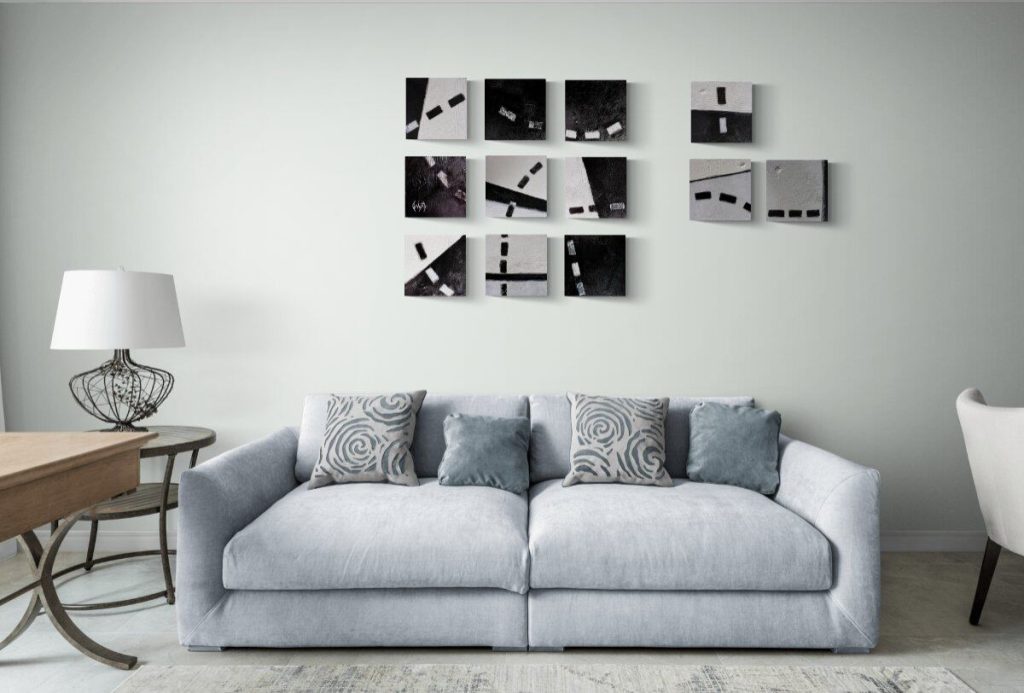
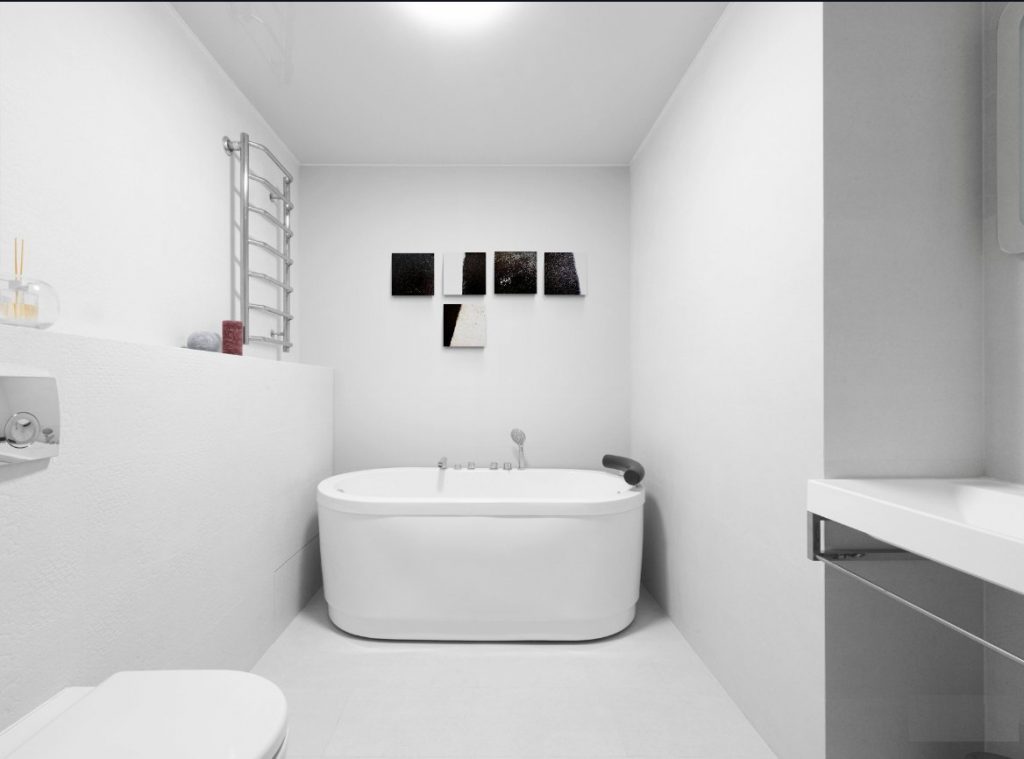
The twelve panels form a constellation shaped by the interior they enter. There is no fixed order: the room, or the areas the work bridges, invites the layout. Hung as a tight grid, they read as one group, its boundary drawn close. Spaced wider, the same group loosens into a coastline: irregular, open, and shaped by the wall and the room it meets.
Panels can also be set apart. One or two may stand alone, holding their own edge at a distance, as an individual might after leaving a group to keep a boundary of their own. The line still carries across the gap.
Beyond a single wall, the panels become a connecting thread. They can turn a corner, cross a doorway, or carry from one room into the next, linking areas that architecture keeps apart. A line that breaks at one panel’s edge is picked up again in another space, and separate rooms read as one continuous field.
The room images on this page are visualisations, made before installation to show how the work could sit in different interiors. They are not photographs of the final installations.